Orrery Space English ऐप खोलो

Orrery Space गाइड

ब्रह्मांड को देखो,
एक-एक कदम

Orrery Space अंतरिक्ष का एक मुफ़्त 3D नक्शा है जिसमें आप उड़ सकते हो: चाँद से ग्रहों तक, अपने ग्रहों वाले तारों तक, हमारी गैलेक्सी के बीच वाले ब्लैक होल तक, और अरबों प्रकाश-वर्ष दूर की गैलेक्सियों तक।

आसान से शुरू करो। जितना चाहो उतना गहरे जाओ।

भाग 1

छह कदमों में ब्रह्मांड

अंतरिक्ष ज़्यादातर खाली है, और बहुत-बहुत बड़ा है। Orrery Space में आप इसे छह कदमों में देख सकते हो, और हर कदम पिछले से कहीं बड़ा है। किसी कदम पर क्लिक करके देखो।

The Moon in Orrery's Moon explorer

चाँद

हमारा सबसे पास का पड़ोसी। Orrery Space में आप पूरे चाँद को घुमा सकते हो, और वहाँ खड़े हो सकते हो जहाँ असली रोबोट उतरेंगे।

Light takes 1.3 seconds to get here.

Go to the Moon
How long light takes: each mark is ten times farther than the one before it. A straight ruler could not fit them on one page.
Moon1.3 s Sun8.3 min Neptune4.2 h Proxima4.2 years Galactic centre27,000 years Andromeda2.5 million years Farthest galaxy2.2 billion years

Why "explorer scale"?

At true scale the planets are specks: Earth is 12,742 km across but 150 million km from the Sun, so a true-scale Solar System on a screen is a few dots in a black field. Orrery's Explorer scale enlarges the bodies and squeezes the distances so you can see everything at once; True scale (top bar) puts every size and distance back. Between the stars, distances are compressed linearly, so the stars keep their true relative distances and the voyage panel tells you by how much.

भाग 2

आपकी पहली उड़ान

पाँच कदम। न अकाउंट, न डाउनलोड, न कुछ इंस्टॉल करना।

  1. Orrery Space खोलो

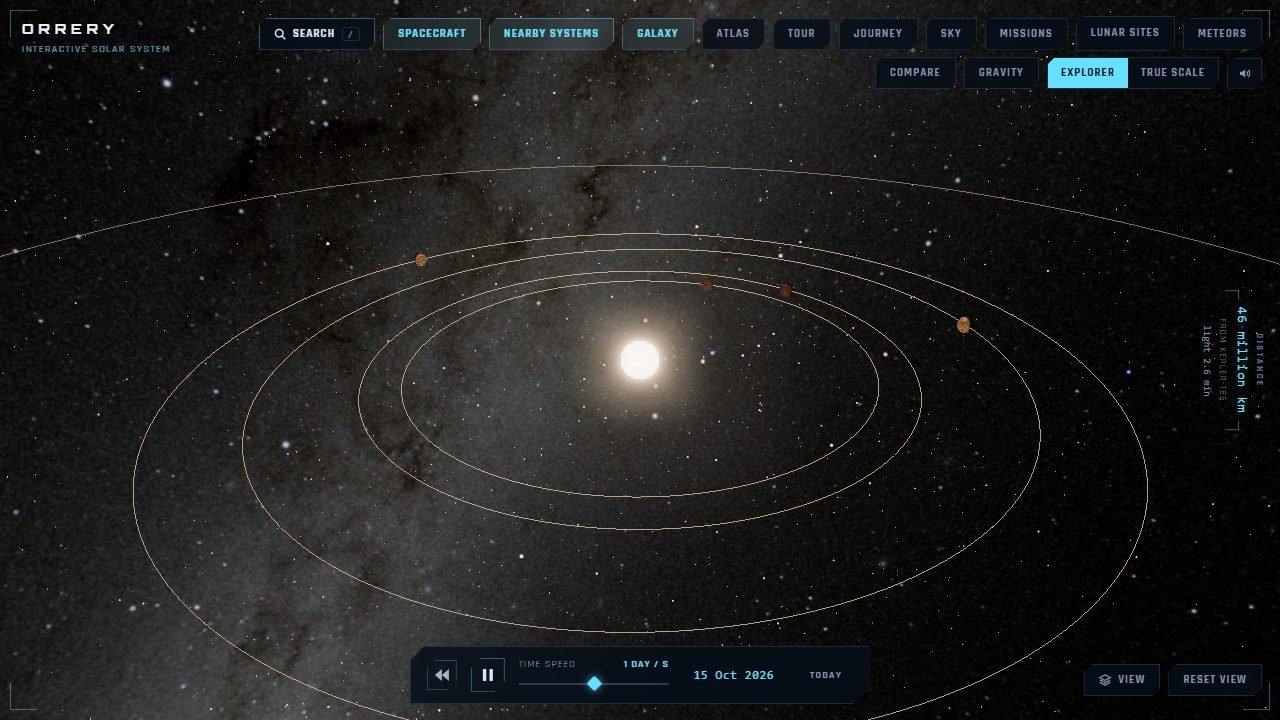
    orreryspace.com/app पर जाओ और Start दबाओ। सूरज और आठों ग्रह दिखेंगे, आज की तारीख की अपनी असली कक्षाओं पर चलते हुए।

  2. किसी ग्रह पर क्लिक करो

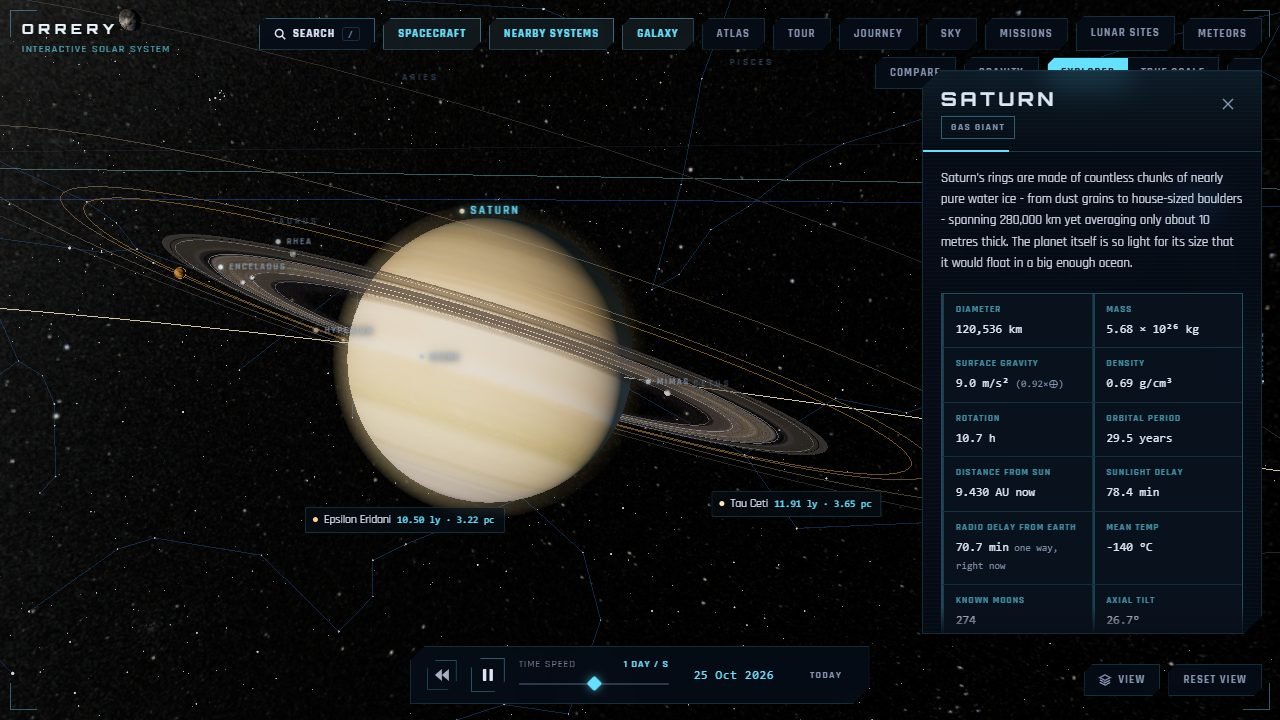
    शनि (Saturn) पर क्लिक करो, या किसी भी दुनिया पर। कैमरा वहाँ उड़कर जाता है और एक कार्ड खुलता है जिसमें उसके बारे में सब कुछ लिखा है: वह कितना बड़ा है, उसका दिन कितना लंबा है, वहाँ कितनी ठंड पड़ती है।

  3. चारों ओर देखो

    खींचो (drag) घुमाने के लिए। स्क्रॉल करो (फ़ोन पर दो उँगलियों से) ज़ूम करने के लिए। पूरा सौर मंडल फिर से देखने के लिए Recentre दबाओ।

  4. कुछ भी खोजो

    / या Search बटन दबाओ और कोई नाम लिखो: Europa, Halley, TRAPPIST-1e, Andromeda. Enter दबाओ और वहाँ पहुँच जाओ।

  5. घर से निकलो

    Galaxy दबाकर सौर मंडल से बाहर आकाशगंगा में उड़ो, या Nearby systems दबाकर किसी दूसरे तारे पर जाओ।

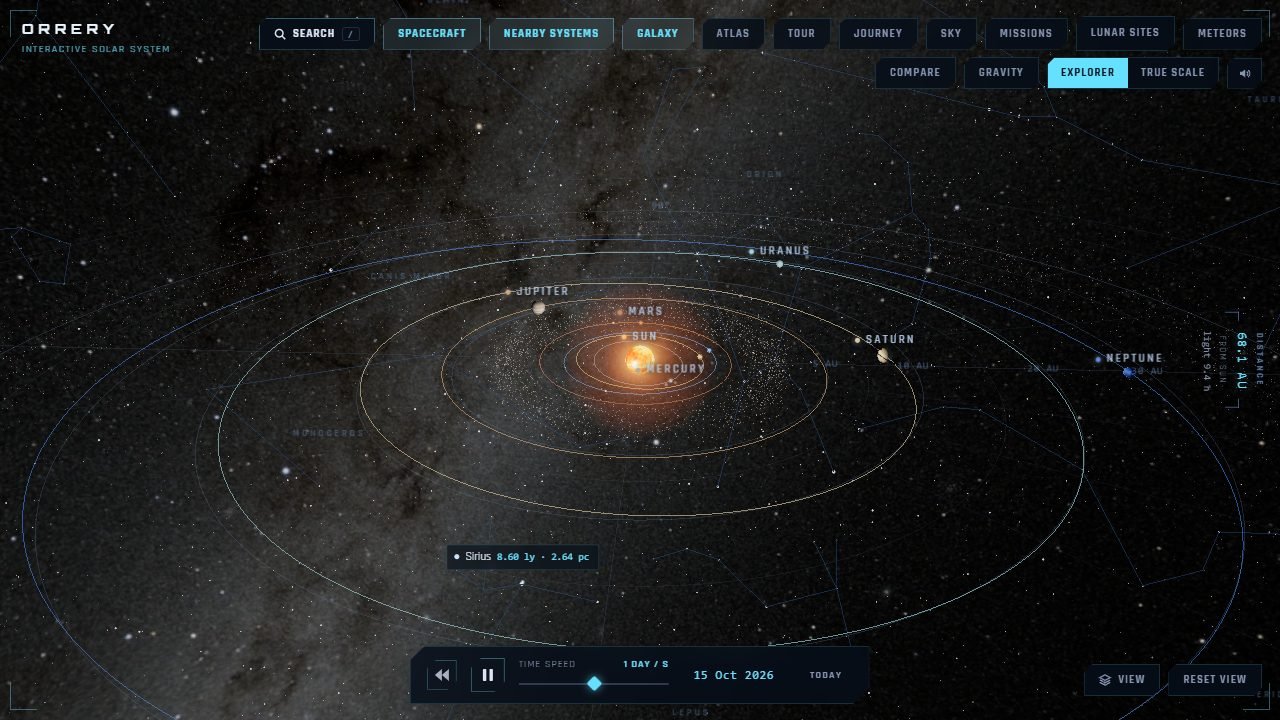
Orrery's Solar System: the Sun, the planets and their orbit paths, with the top bar of buttons
कदम 1: पूरा सौर मंडल, आज।
Saturn up close in Orrery, with its information card open
कदम 2: किसी दुनिया पर क्लिक करो और वहाँ उड़ो।

The buttons along the top

Search /
Find any planet, moon, comet, mission, star system, exoplanet, star cluster or galaxy.
Atlas
Every world in one list, grouped: planets, moons, dwarf planets, asteroids, comets.
Tour
A guided walk through the Solar System, stop by stop.
Journey
Ride a probe out to the outer planets.
Spacecraft
Board a research vessel and fly the real Solar System from its cockpit, with real orbits and burns.
Nearby systems
Travel to other stars: 13 hand-checked neighbours and 4,728 more planetary systems.
गैलेक्सी
Leave the Solar System and fly the Milky Way, its star clusters, its central black hole, and the galaxies beyond.
Sky
The Observatory: the night sky from anywhere on Earth, its stars and deep-sky objects.
Missions
Real spacecraft and where they went.
Lunar sites
The Lunar Mission Browser: compare landing sites at the Moon's south pole.
Meteors
Meteor showers and the comets that cause them.
Compare
Sizes and distances side by side.
Gravity
Your weight on every world.
Explorer / True
Switch between the enlarged view and real sizes and distances.
Time bar
At the bottom: pause, run time faster or backwards, pick any date, or jump back to Today.

On a phone the same tools sit in the bar at the bottom: Fly, Atlas, Sky, and More for the rest.

भाग 3

देखने की दस जगहें

हर कार्ड Orrery Space को ठीक उसी जगह खोलता है। लेवल 2 बताता है क्या आज़माना है; लेवल 3 बताता है क्या असली है।

Saturn and its rings in Orrery

सौर मंडल

सूरज, आठ ग्रह, उनके चाँद, और बहुत सारे धूमकेतु और बौने ग्रह। सब वहीं चलते हैं जहाँ आज सच में हैं।

Try this

  • Click Earth, then Interior to cut it open and see its layers.
  • Drag the time bar to watch the planets move. Comets swing past the Sun.
  • Turn on the asteroid belt and the Kuiper belt in View.

What is real

Planet surfaces are NASA and USGS maps. Positions come from published orbital elements and ephemerides. Earth uses NASA's Blue Marble, Black Marble city lights and real clouds (from 2001, not today's weather).

सौर मंडल खोलो
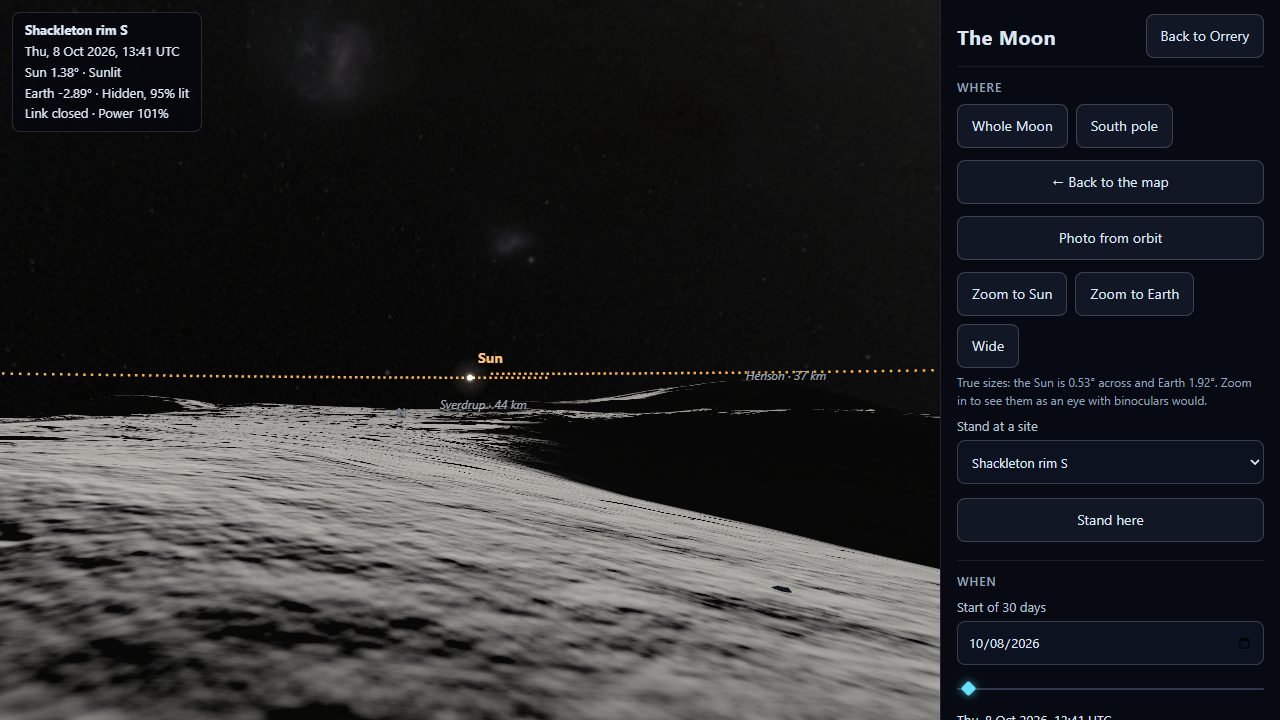
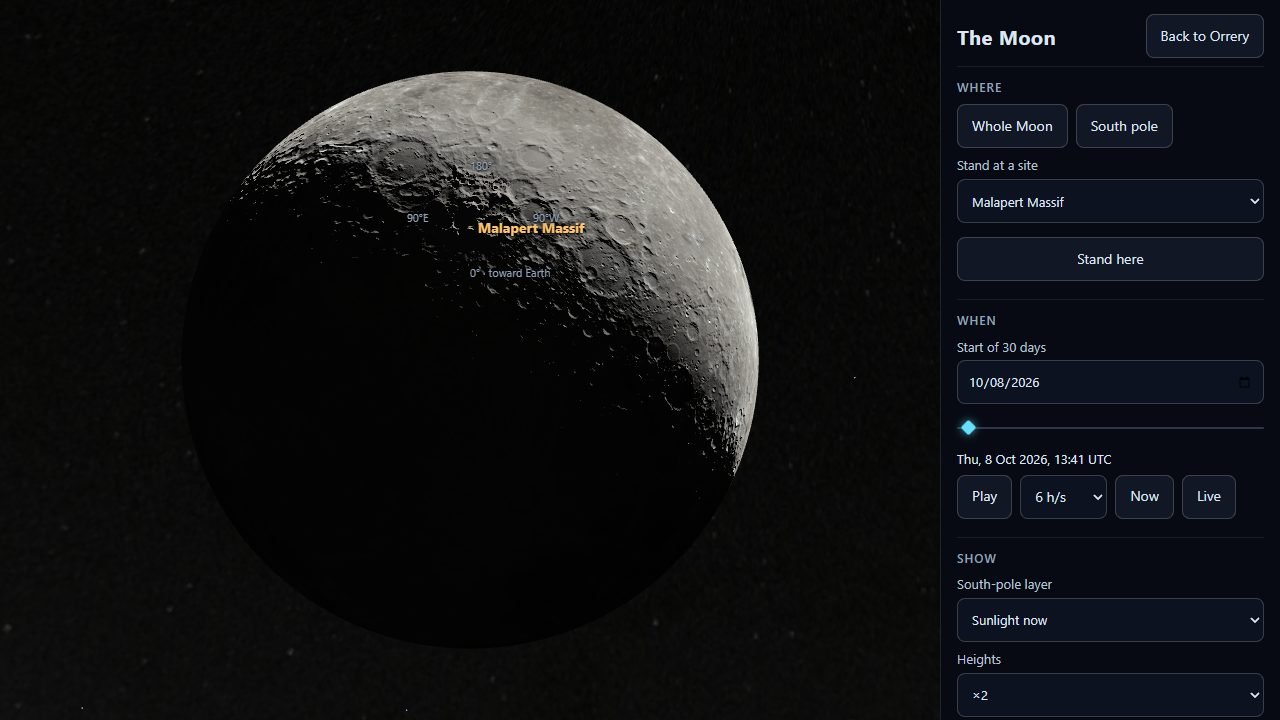
Standing on the Moon near Shackleton crater: grey ground, the long shadow of the rim, and the black sky

चाँद पर खड़े हो

पूरे चाँद को घुमाओ, फिर वहाँ खड़े हो जाओ जहाँ एक रोबोट उतरेगा, और चारों ओर देखो: ज़मीन, और काले आसमान में सूरज और पृथ्वी।

Try this

  • Click a site near the south pole, then Stand here.
  • Press Live to see the sky as it is at this very moment.
  • Use Zoom to Earth: from the Moon, Earth looks about 2° wide, almost four times the Moon's width in our sky.

What is real

The ground is NASA's LOLA laser-altimeter data: a 5 m grid for 4 km around eight landing sites, then 10 m, 120 m and 720 m rings out to 150 km. Lighting is computed from the real Sun position. The Sun and Earth are drawn at their true angular sizes. Rocks and small craters are procedural and labelled so.

चाँद देखो
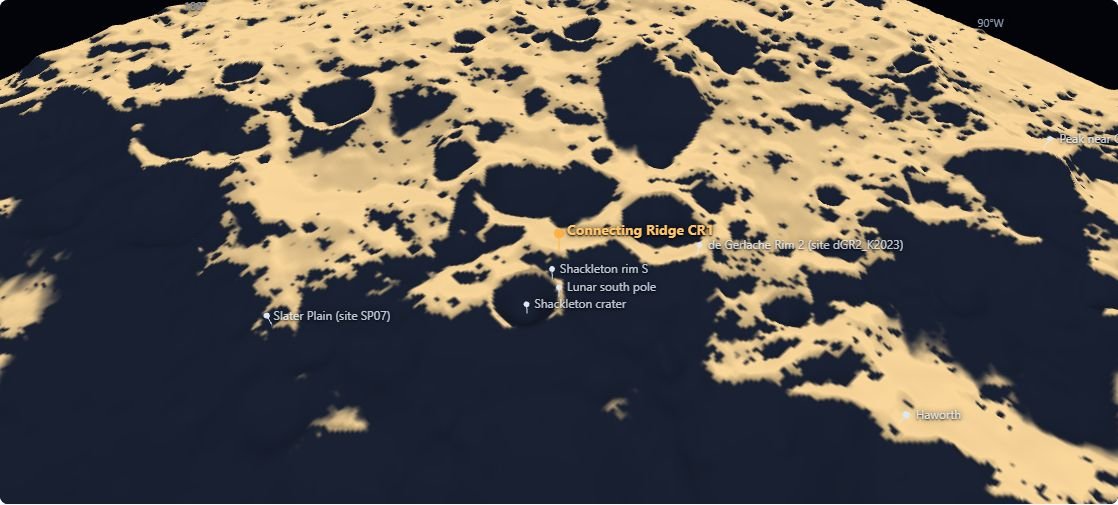
The Moon's south pole in 3D, lit for a chosen hour

चाँद पर उतरने की योजना

मिशन प्लानर बनो: चाँद के दक्षिणी ध्रुव पर कहाँ सोलर पैनल के लिए धूप मिलेगी, और कहाँ से पृथ्वी दिखेगी ताकि घर बात हो सके?

Try this

  • Pick two sites and compare their sunlight over a month.
  • Raise the mast: a taller antenna sees Earth more often.
  • Open the 30-day heat map: crater rims glow, crater floors stay dark.

What is real

Terrain from LOLA, Earth and Sun positions checked against JPL Horizons, and the Deep Space Network's real antennas. The browser runs more than 250 automatic checks.

Lunar Mission Browser खोलो
The Alpha Centauri system in Orrery

पड़ोस के तारे

हमारा सूरज एक तारा है। दूसरे तारे भी सूरज हैं, और कुछ के पास ग्रह भी हैं। सबसे पास वाले Alpha Centauri तक कुछ ही सेकंड में पहुँचो।

Try this

  • Press Nearby systems and pick Proxima Centauri.
  • Turn on the रहने लायक क्षेत्र (habitable zone): the green band where water could be liquid.
  • Visit TRAPPIST-1: seven Earth-sized planets, closer to their star than Mercury is to ours.

What is real

Thirteen systems out to 40.7 light-years, hand-checked: Gaia DR3 distances, NASA Exoplanet Archive planets, interferometry for Alpha Centauri and Sirius. A radius worked out from a mass is labelled estimated, and a minimum mass is labelled minimum.

तारों पर जाओ
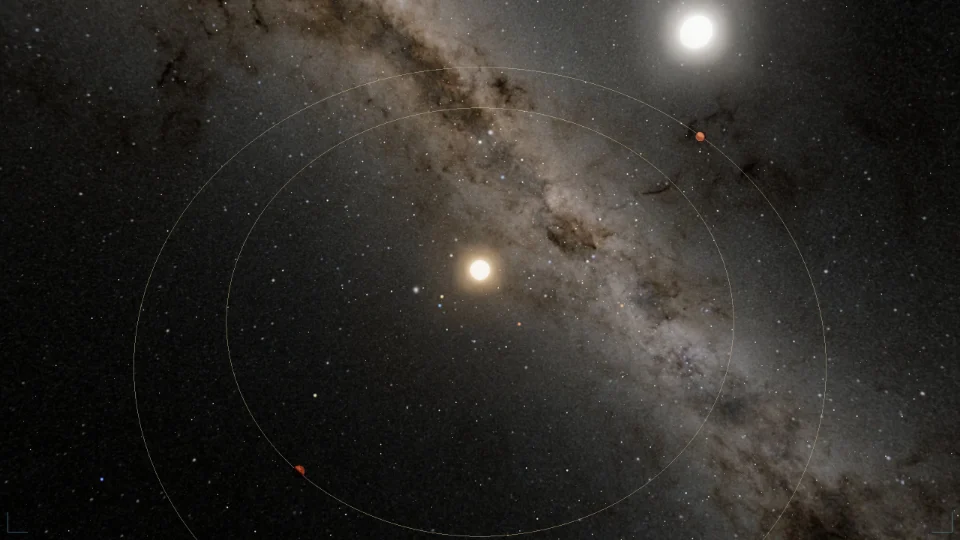
The Kepler-186 system in Orrery: a red dwarf and its five planets on their orbits

4,728 दूसरे ग्रह-सिस्टम

वैज्ञानिकों ने दूसरे तारों के चारों ओर 6,000 से ज़्यादा ग्रह खोजे हैं। जिस-जिस की कक्षा पता है, वह सब Orrery Space में है, और आप किसी पर भी उड़ सकते हो।

Try this

  • Search Kepler-452 b, a planet a bit bigger than Earth with a year of 385 days.
  • In Nearby systems, type in the All known systems filter: TOI-700, HD 189733, 51 Peg.
  • Open a planet's card: it says how it was found and in which year.

What is real

Every number comes from the NASA Exoplanet Archive (6,299 planets). Alternative names (KOI, TOI, Gliese) come from Celestia. When only one of period or orbit size is known, the other is worked out from Kepler's third law, and the card says so. Planet colours are artist's renderings: almost none of these worlds has ever been photographed.

Kepler-186 पर उड़ो

पढ़ना पसंद है? हर सिस्टम का अपना पेज है।

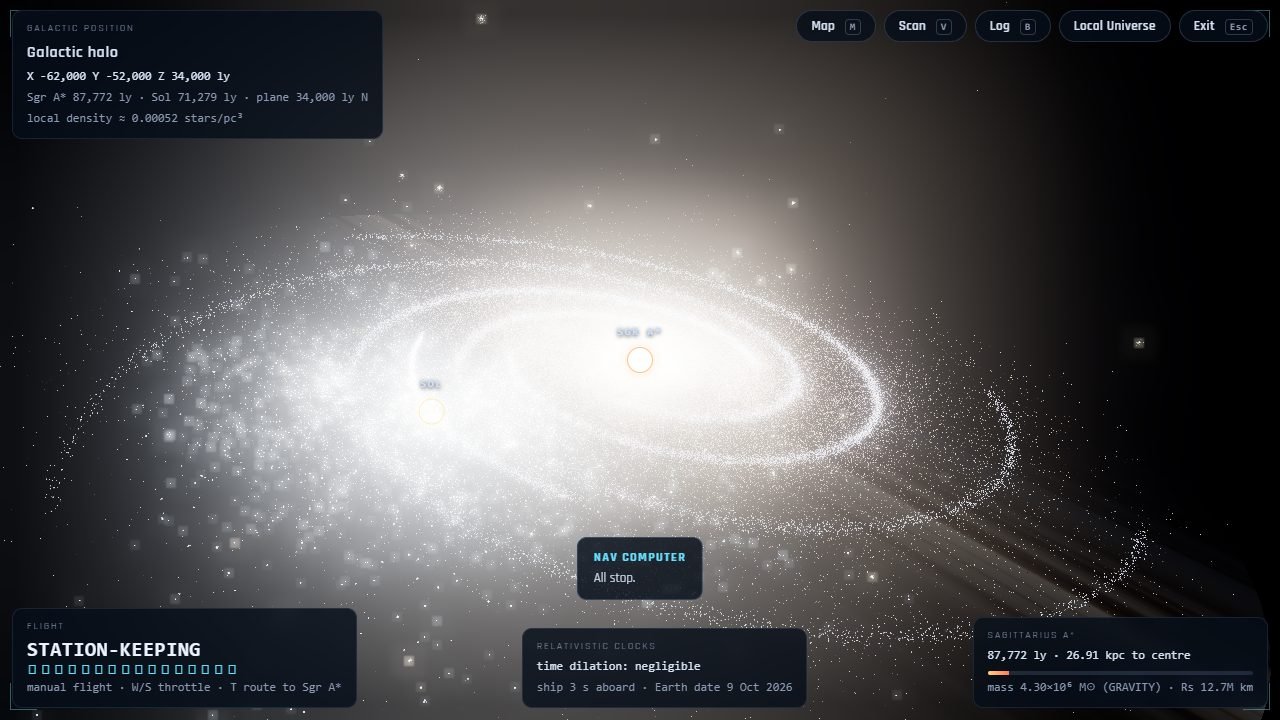
The Milky Way seen from outside in Orrery's galaxy mode

आकाशगंगा (Milky Way)

हमारी गैलेक्सी: एक घुमावदार चक्र में सैकड़ों अरब तारे, 100,000 प्रकाश-वर्ष चौड़ा। सूरज उसमें एक छोटा-सा बिंदु है, लगभग आधे रास्ते पर।

Try this

  • Hold W to speed up and S to slow down. Drag to steer.
  • Press M for the galaxy map, click a place, then Engage route: the autopilot flies you there.
  • Press V to scan nearby objects into your survey log (B).

What is real

The shape follows published measurements: a 2.6 kpc disc, a long bar at 28°, two major arms, two minor ones, and the Orion Spur that holds the Sun, 26,996 light-years from the centre. Individual stars beyond the catalogues are procedural, seeded so they are the same every visit.

आकाशगंगा में जाओ
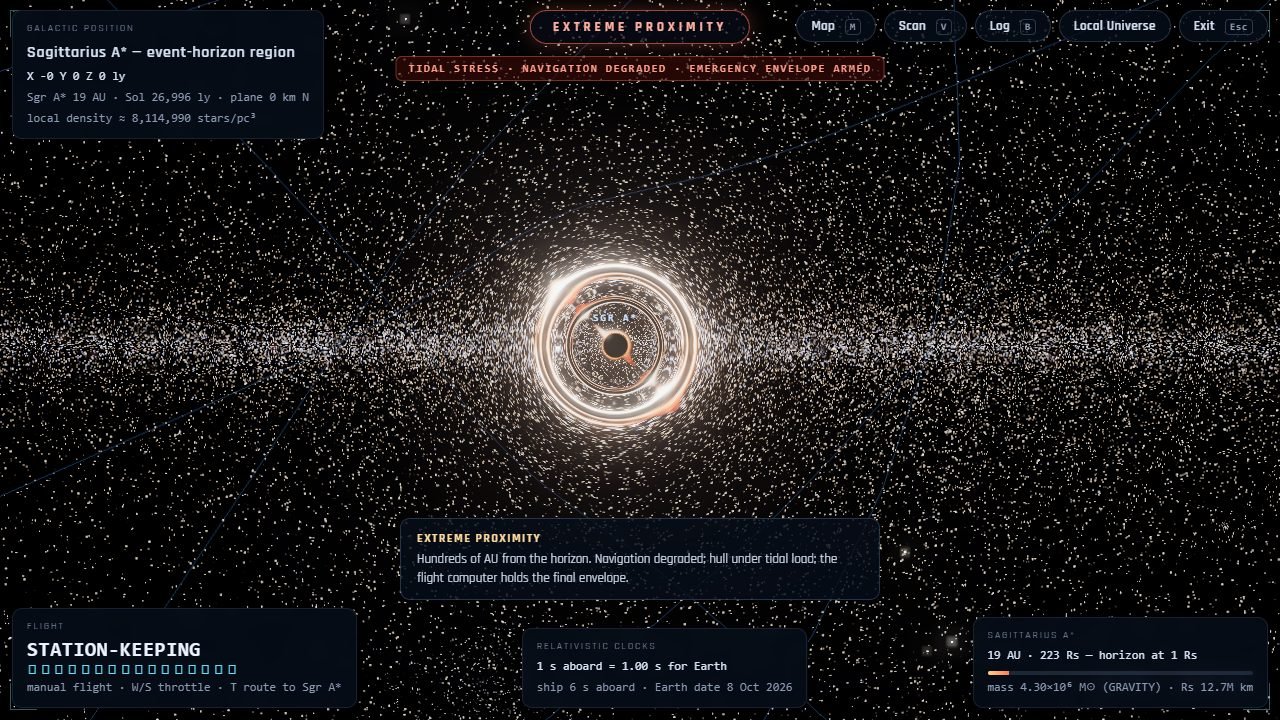
Sagittarius A*, the black hole at the centre of the Milky Way, with light bent around it

बीच का ब्लैक होल

हमारी गैलेक्सी के ठीक बीच में एक ब्लैक होल है, जो 43 लाख सूरजों जितना भारी है। उसकी गुरुत्वाकर्षण इतनी तेज़ है कि रोशनी भी उसके चारों ओर मुड़ जाती है।

Try this

  • Fly close: the stars behind it stretch into rings.
  • Watch the ship's clock: near the black hole your time runs slower than Earth's.
  • Find the S-stars that orbit it in only a few years.
  • Race the star S2 through its pass of the hole in May 2018: keep pace as it speeds up sixteen-fold.

What is real

Mass from the GRAVITY collaboration (2022), imaged by the Event Horizon Telescope. The lensing is computed by ray-marching around the hole, and time dilation by the Schwarzschild formula. The S-stars follow published orbits.

Sagittarius A* पर चलो S2 तारे के साथ दौड़ लगाओ
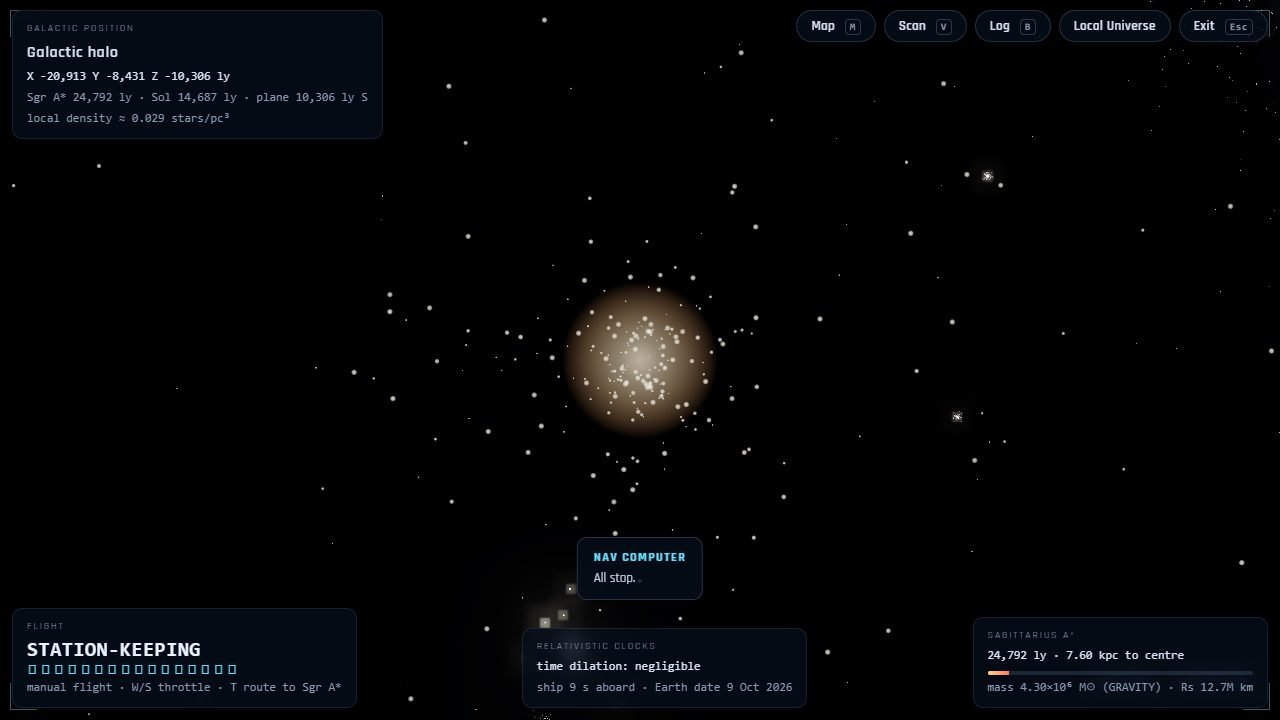
The globular cluster 47 Tucanae seen from 600 light-years away in galaxy mode

तारा-समूह

कुछ तारे भीड़ में रहते हैं। जवान तारे Pleiades जैसे ढीले झुंडों में; बहुत बूढ़े तारे लाखों तारों के बड़े-बड़े गोलों में।

Try this

  • Search 47 Tuc or Omega Centauri, the two biggest globular clusters you can see without a telescope.
  • Search Pleiades, the Seven Sisters, 443 light-years away.
  • On the galaxy map: globular clusters crowd round the centre; open clusters crowd round the Sun.

What is real

All 196 globular clusters of Baumgardt et al. (2023), with their measured core and tidal radii, and 6,476 open clusters of the Unified Cluster Catalogue (Perren et al. 2023). Open clusters bunch near the Sun because dust hides the far ones, not because they are not there. Member stars are drawn procedurally inside each cluster's measured size.

आकाशगंगा में जाओ
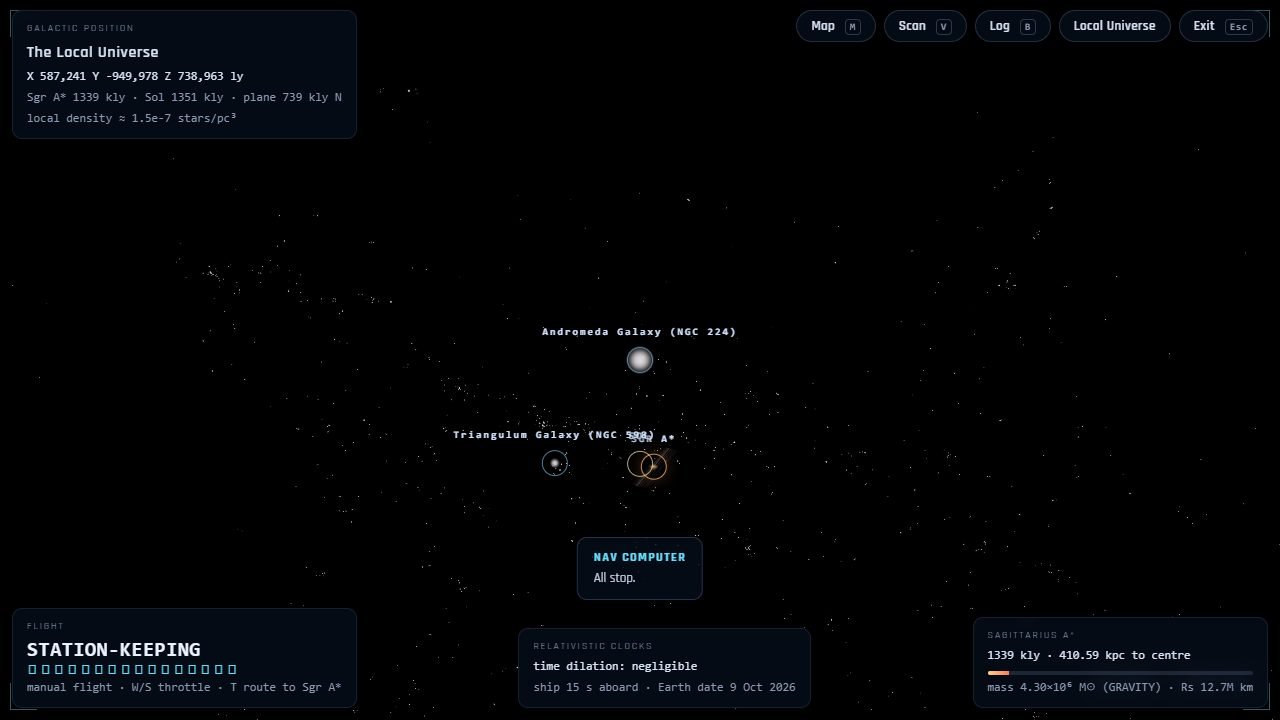
The Local Universe: the Milky Way and thousands of galaxies around it, with Andromeda ahead

लोकल यूनिवर्स

हमारी गैलेक्सी अनगिनत गैलेक्सियों में से एक है। इससे बाहर निकलो और 10,933 गैलेक्सियों को उनकी असली दूरी पर देखो, फिर किसी एक तक उड़ो।

Try this

  • In galaxy mode press Local Universe. Andromeda is straight ahead.
  • Open the map, search M 87 or Sombrero, and engage the route.
  • Arrive at a galaxy: its shape (spiral, barred, round) follows its real type, tilt and size.

What is real

Positions and sizes from Steinicke's Revised NGC/IC catalogue, with distances from NED, Cepheids, the tip of the red-giant branch, surface-brightness fluctuations or Tully-Fisher, otherwise from redshift (H₀ = 73.2). The tilt of each galaxy reproduces published position angles to within a few degrees. The stars, arms and bars you fly through are procedural.

लोकल यूनिवर्स में कदम रखो
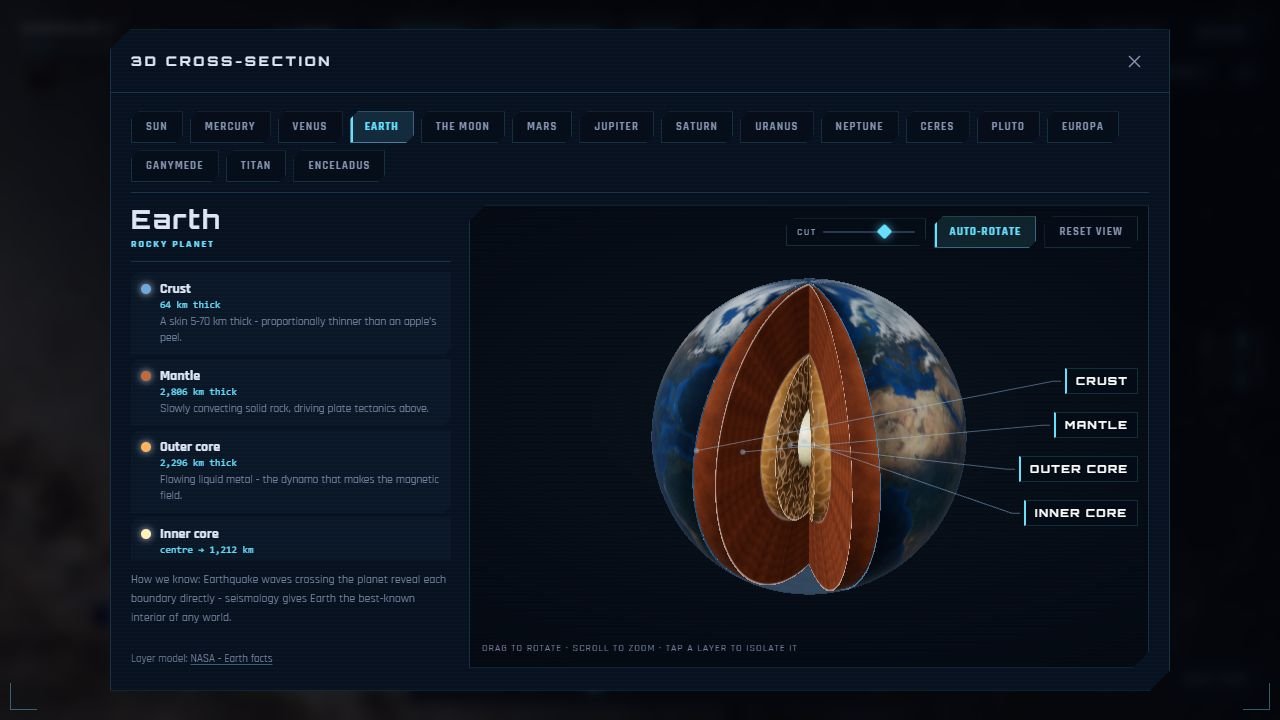
A cutaway of Earth in Orrery showing its crust, mantle and core

सीखने के औज़ार

Orrery Space के अंदर छिपे छोटे-छोटे सबक: मंगल पर आपका वज़न कितना होगा, पृथ्वी के बगल में बृहस्पति कितना बड़ा है, उल्का-वर्षा क्यों होती है।

Try this

  • Gravity: type your weight and see it on every world.
  • Compare: line up planets by size.
  • Meteors: find the comet behind each shower.
  • On Earth's card, Earth-Moon lab: tides, eclipses and phases.

What is real

Surface gravities, sizes and meteor radiants from NASA and IAU data, with the source named on each card.

Orrery Space खोलो

भाग 4

कंट्रोल

माउस

क्लिक चुनने के लिए। खींचो घुमाने के लिए। स्क्रॉल ज़ूम के लिए।

टच

टैप चुनने के लिए। स्वाइप घुमाने के लिए। पिंच ज़ूम के लिए।

कीबोर्ड

/ खोज · Esc बंद करो या पीछे जाओ

In galaxy mode

Galaxy mode keys
W / SFaster / slower, through a ladder of warp speeds. The fastest steps open only well outside the Milky Way.
DragSteer the ship
MGalaxy map: search, click a destination, Engage route
TRoute to Sagittarius A*
VScan what is near you
BSurvey log of everything you have scanned
EscLeave galaxy mode

भाग 5

क्या यह असली है?

नापा हुआ

चीज़ें कहाँ हैं, कितनी बड़ी हैं, कैसे चलती हैं। ये सब NASA, ESA और खगोलशास्त्रियों की सूचियों से आता है, और हर संख्या का एक स्रोत है।

कल्पना किया हुआ, और बताया हुआ

जिसकी अभी तक किसी ने फ़ोटो नहीं ली: दूर के ग्रहों के रंग, किसी तारा-समूह के अलग-अलग तारे, किसी दूर की गैलेक्सी की भुजाएँ। जब Orrery Space कोई ऐसी तस्वीर दिखाता है जो उसे खुद बनानी पड़ी, तो वह हमेशा बता देता है।

Sources

WhatFrom
Planet and moon surfacesNASA, USGS and mission mosaics; Earth from NASA Blue Marble and Black Marble
Orbits and positions in the Solar SystemPublished orbital elements; JPL Horizons for checks
The Moon's terrain and photosLRO LOLA (5 m–1 km grids), LRO WAC and NAC images
Nearby starsGaia DR3 parallaxes via SIMBAD; Hipparcos for the brightest
Exoplanets (6,299 + hand-checked 13 systems)NASA Exoplanet Archive pscomppars; names from Celestia
Habitable zonesKopparapu et al. (2014)
The Milky Way's shapePublished disc, bar and arm geometry; R₀ = 8.277 kpc (GRAVITY)
Sagittarius A*GRAVITY 2022 mass; Event Horizon Telescope
Globular clusters (196)Baumgardt et al. (2023), MNRAS
Open clusters (6,476)Unified Cluster Catalogue, Perren et al. (2023)
Galaxies (10,933)Steinicke's Revised NGC/IC; distances from NED-1D and named methods

The full list, with links and licences, is in the project's SOURCES.md. Every world in Explore lists its own sources.

भाग 6

अंतरिक्ष के शब्द

कक्षा (orbit)
वह रास्ता जिस पर एक चीज़ दूसरी के चारों ओर घूमती है, जैसे पृथ्वी सूरज के चारों ओर।
प्रकाश-वर्ष
रोशनी एक साल में जितनी दूर जाती है: 9.46 खरब किलोमीटर। यह दूरी है, समय नहीं।
चाँद (moon)
एक दुनिया जो किसी ग्रह के चारों ओर घूमती है। बृहस्पति के पास दर्जनों हैं।
एक्सोप्लैनेट
ऐसा ग्रह जो हमारे सूरज के नहीं, किसी और तारे के चारों ओर घूमता है।
रहने लायक क्षेत्र (habitable zone)
तारे से वह दूरी जहाँ किसी ग्रह की सतह पर पानी तरल रह सकता है। इसका मतलब यह नहीं कि वहाँ कोई रहता है।
तारा-समूह
तारों का एक परिवार जो साथ पैदा हुआ और अब भी साथ चलता है।
गैलेक्सी
तारों, गैस और धूल का एक विशाल शहर, जिसे गुरुत्वाकर्षण ने जोड़ रखा है। हमारी गैलेक्सी Milky Way है।
ब्लैक होल
इतनी छोटी जगह में इतना ज़्यादा द्रव्यमान कि रोशनी भी बाहर नहीं निकल पाती।
AU
Astronomical unit: Earth's average distance from the Sun, 149.6 million km.
Parsec
3.26 light-years: the distance at which a star shifts by one arcsecond as Earth goes round the Sun.
Parallax
That shift. Measuring it (Gaia does it for over a billion stars) is how star distances are known.
Hubble type
A galaxy's shape class: E (elliptical, E0 round to E6 flat), S0 (lenticular), Sa–Sc (spirals, tight to loose), SB (barred), Irr (irregular).
Minimum mass
A planet found by its star's wobble gives only M sin i: its true mass is at least this, more if its orbit is tilted toward us.
भाग 7

सवाल

क्या इसके पैसे लगते हैं?

नहीं। Orrery Space मुफ़्त है, बिना साइन-अप के, और आपके वेब ब्राउज़र में चलता है।

क्या यह मेरे फ़ोन पर चलेगा?

हाँ। नया फ़ोन चल जाता है; ग्राफ़िक्स कार्ड वाले कंप्यूटर पर उड़ान सबसे स्मूद रहती है। होम पेज आपके डिवाइस की जाँच खुद कर लेता है।

दूरियों के मुकाबले ग्रह इतने बड़े क्यों दिखते हैं?

वह Explorer स्केल है, ताकि आप उन्हें देख सको। असली अनुपात के लिए ऊपर की पट्टी में True स्केल चुनो।

क्या मैं इसे क्लास में इस्तेमाल कर सकता हूँ?

ज़रूर करो। शिक्षकों के लिए पाँच तैयार पाठ हैं, Lunar Mission Browser में एक क्लिक के उदाहरण हैं जिनसे एक छोटा पाठ बन जाता है, और Explore में हर दुनिया की प्रिंट करने लायक गाइड है।

Something looks wrong. What do I do?

Orrery labels everything it had to estimate or imagine. If a number seems off, check the source named on its card; if it is still wrong, tell us, and we will fix it.

तैयार?

ब्रह्मांड इंतज़ार कर रहा है। एक क्लिक से शुरू करो।

शुरू ऑनलाइन 3D मॉडल