Orrery for teachers
Seven lessons in a
free 3D model of space
Each lesson takes about 30 minutes, needs nothing but a web browser, and has a goal, steps in the app, three questions for the class, and a worksheet that prints on its own page. Press Print this page for all seven worksheets at once.
Ages 10 to 16. No sign-up, no cost.
- 1 · Scale
- 2 · Moon phases
- 3 · Exoplanets
- 4 · The Milky Way
- 5 · The Moon's south pole
- 6 · Mars
- 7 · Kepler and S2
- In the curriculum
The answers are folded away under each worksheet, so the page can go on a projector. Print this page leaves them out; Print the answers prints only them.
Lesson 1
How big is the Solar System?
In the curriculum. NCERT Curiosity, Grade 6, Ch. 12 “Beyond Earth” (12.3, Our Solar System). NGSS MS-ESS1-3. Light-years and the time light takes go beyond the NCERT chapter.
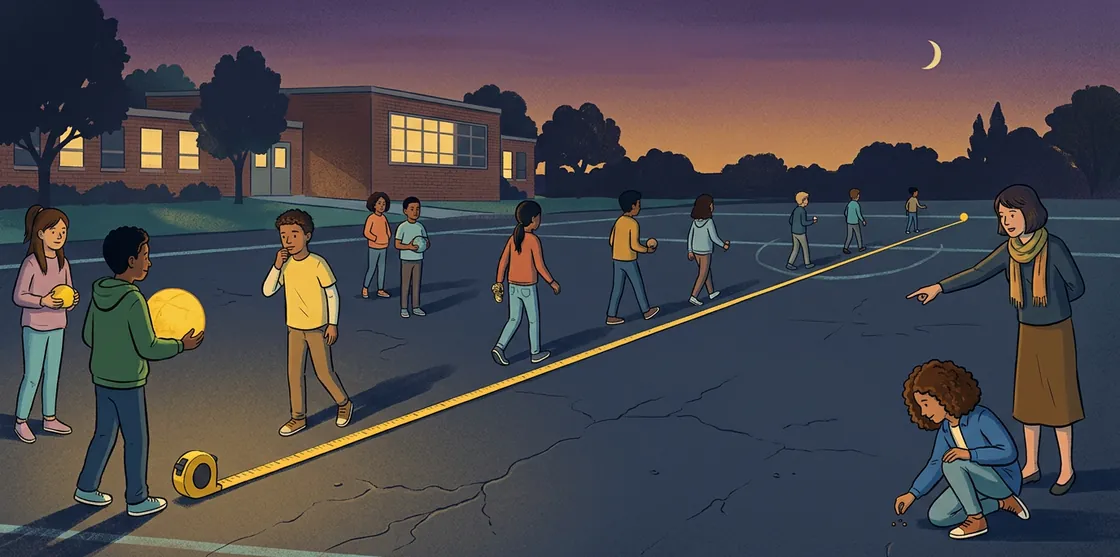
Goal. Students see for themselves that the planets are tiny compared with the space between them, and can say why every picture of the Solar System in a book is drawn "wrong".
Steps in the app
- Open Orrery and press Start. The Solar System is in Explorer scale: the planets are drawn big so you can see them.
- Click Earth. Read its card: diameter 12,756 km, 149.6 million km from the Sun. Ask: how many Earths fit between here and the Sun?
- In the top bar switch to True scale. The planets shrink to dots. Fly out to Neptune: light from the Sun takes four hours to get here.
- Press Search and type "Voyager": the probes left in 1977 and are still inside the Sun's influence. Ask what that says about the size of the gap to the next star.
- Finish with Nearby star systems: Proxima Centauri is 4.2 light-years away, 270,000 times Earth's distance from the Sun.
Ask the class
- If the Sun were a football, how big would Earth be, and how far away?
- Why do books draw the planets so close together?
- Light takes 8 minutes to reach Earth and 4 hours to reach Neptune. How long to Proxima Centauri?
Worksheet: a Solar System you can walk
Name Class Date
- Find each planet in Orrery and write its distance from the Sun in millions of km: Mercury Venus Earth Mars Jupiter Saturn Uranus Neptune
- If Earth's distance is 1 step, how many steps to each planet? Mark them on a line across the page.
- In True scale, which planet was hardest to find? Why?
Answers for the teacher
Lesson 1 · How big is the Solar System?
In the app
- Earths between Earth and the Sun: about 11,700 (149.6 million km ÷ 12,756 km).
Ask the class
- A peppercorn, about 2 mm across, some 24 metres away. A 22 cm football for a Sun 1,391,400 km wide makes Earth's 12,756 km a fifth of a centimetre, and its 149.6 million km 23.6 m.
- To scale the planets would be specks too small to print, and a page wide enough for Neptune's orbit would leave Earth a dot near the middle. Books trade the true distances for pictures you can see.
- About 4.2 years: Proxima Centauri is 4.2 light-years away, and a light-year is how far light goes in a year.
Worksheet
- Mean distances from the Sun, as the planets' cards give them, in millions of km: Mercury 57.9, Venus 108.2, Earth 149.6, Mars 227.9, Jupiter 778.3, Saturn 1,426.7, Uranus 2,870.7, Neptune 4,498.4.
- With Earth at 1 step: Mercury 0.4, Venus 0.7, Earth 1, Mars 1.5, Jupiter 5.2, Saturn 9.5, Uranus 19.2, Neptune 30.1. These steps are astronomical units.
- Any reasoned answer. Mercury is small and lost near the Sun; Uranus and Neptune are tiny dots far apart.
Lesson 2
Why the Moon changes shape
In the curriculum. NCERT Curiosity, Grade 7, Ch. 12 “Earth, Moon, and the Sun” (12.3, eclipses) and Curiosity, Grade 8, Ch. 11 “Keeping Time with the Skies” (11.1.1, phases of the Moon). NGSS MS-ESS1-1. NCERT says the Moon’s orbit has a “small tilt”; the 5° is from the app.
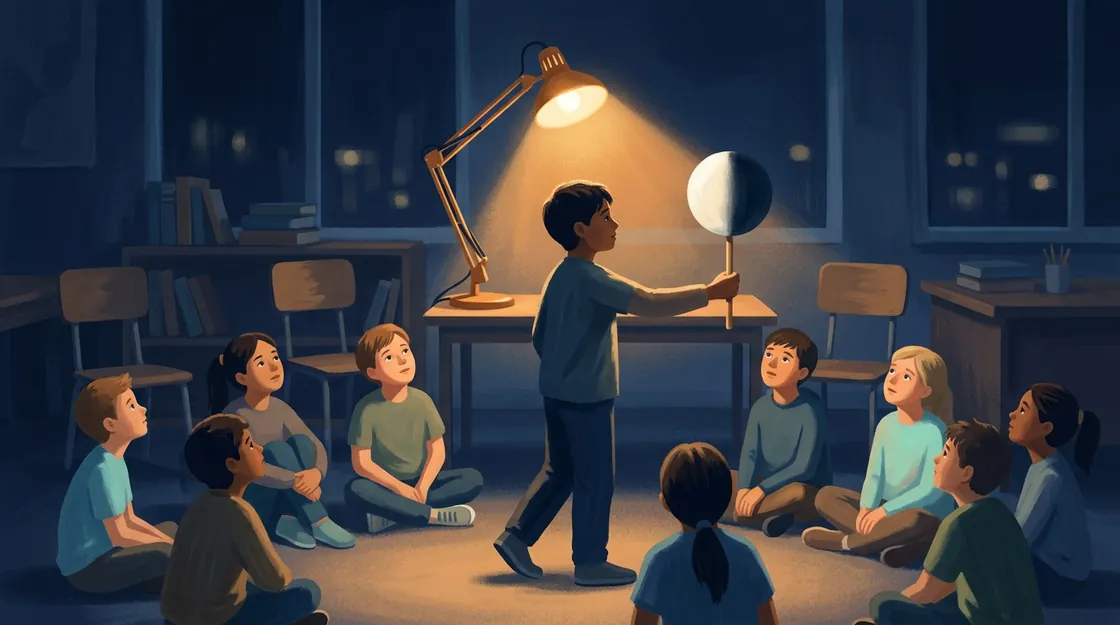
Goal. Students explain the phases as the Moon's lit half seen from different angles, not as Earth's shadow, and predict tonight's phase.
Steps in the app
- Open the Earth–Moon lab. It shows the Sun, Earth and the Moon today, with the Moon's lit half facing the Sun.
- Drag the Moon round its orbit. Watch the small "from Earth" view: the lit part grows from a crescent to full and back.
- Open This month: the calendar of phases. Find today, the next full Moon and the next new Moon.
- Put the Moon exactly between Earth and the Sun: a solar eclipse. Ask why it does not happen every month (the orbit is tilted 5°).
- Click the Moon itself and read how far it is: 384,400 km, 30 Earths side by side.
Ask the class
- Where is the Sun when the Moon is full? Where is it at new Moon?
- Can you see a crescent Moon at midnight?
- What would the phases look like from the Moon, watching Earth?
Worksheet: the month ahead
Name Class Date
- Draw the Moon as it looks tonight, and write its phase and how much is lit (the lab says).
- Date of the next full Moon: Date of the next new Moon:
- In one sentence, why is a half Moon not "half in Earth's shadow"?
Answers for the teacher
Lesson 2 · Why the Moon changes shape
Ask the class
- At full Moon the Sun is behind us: Earth sits between it and the Moon, so we face the Moon's lit side. At new Moon the Sun is behind the Moon, and we face its dark side.
- Hardly ever. A crescent is close to the Sun in the sky, so it sets soon after sunset (the evening crescent) or rises shortly before sunrise (the morning one).
- Earth shows phases too, the opposite of the Moon's: a full Earth at new Moon, a thin crescent of Earth at full Moon.
Worksheet
- On the day you open this page the lab shows the Moon as it is tonight.
- From the lab's calendar: the next full Moon is marked ● there, the next new Moon is marked ○.
- We see half of the half the Sun lights, because the Moon is a quarter of the way round its orbit. Earth's shadow reaches the Moon only in a lunar eclipse, and only at full Moon.
Lesson 3
Planets around other stars
In the curriculum. NCERT Curiosity, Grade 8, Ch. 13 “Our Home: Earth, a Unique Life Sustaining Planet” (13.3.1, the habitable zone). NGSS has no middle-school standard on exoplanets; MS-ESS1-3 as an extension. The transit method goes beyond the NCERT chapter.
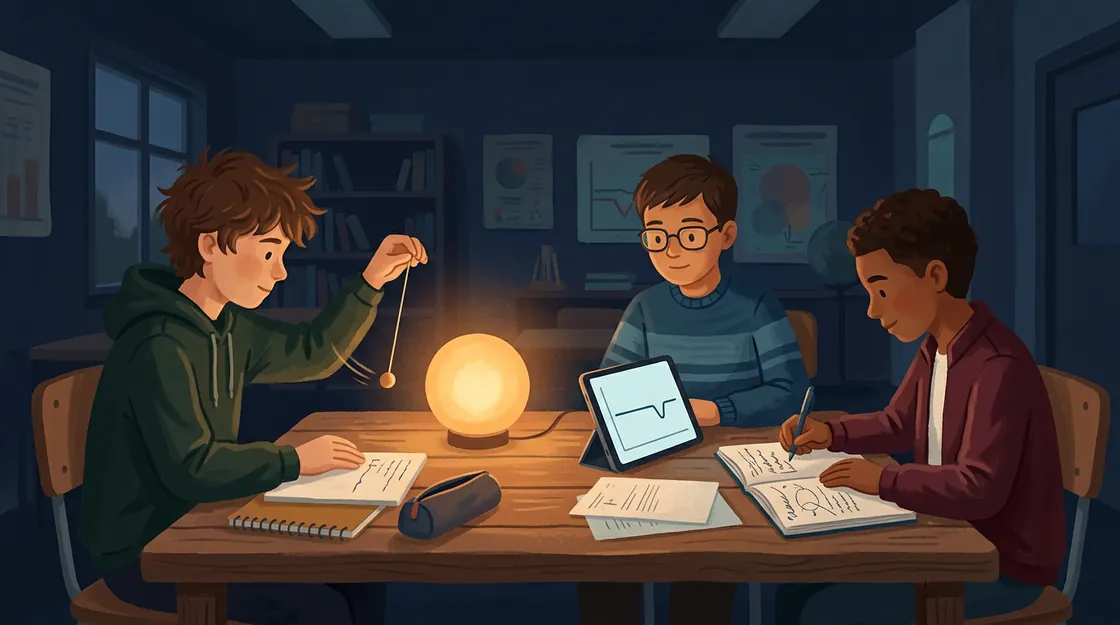
Goal. Students find a real exoplanet, read where its numbers come from, and judge whether it could have liquid water.
Steps in the app
- Open TRAPPIST-1: seven Earth-sized planets round a star smaller than Jupiter's orbit, 40 light-years away. The green band is the habitable zone.
- Click each planet. The card says how it was found (its star dims when it passes in front: the transit method) and whether the mass is measured or a minimum.
- Fly to Kepler-186 f, the first Earth-sized planet found in a habitable zone. Compare its year (130 days) with ours.
- Press Search and type the name of any star the class knows. Orrery has 4,728 systems from NASA's archive; the card names the constellation.
- Open the systems list and sort by distance: how many lie within 20 light-years?
Ask the class
- Why is a planet in the habitable zone not necessarily habitable? Think of Venus.
- Why do we know a planet's size from a transit, but its mass from the star's wobble?
- Kepler-186 f is 580 light-years away. If we sent a message today, when would the earliest reply arrive?
Worksheet: planet report
Name Class Date
- Choose one exoplanet. Its name, its star, and its distance from us:
- How was it discovered, and in what year?
- Its size compared with Earth, and its year in days:
- Could it have liquid water? Give one reason for and one against.
Answers for the teacher
Lesson 3 · Planets around other stars
Ask the class
- The zone only says the starlight could keep water liquid on a surface. The planet also needs air of the right kind and enough mass to hold on to it. Venus lies near the inner edge of our Sun's zone and is 464 °C under thick carbon dioxide.
- A transit dims the star by the share of its disc the planet covers, which gives the planet's size. The mass needs the star's wobble: a heavier planet tugs its star harder, and the star's light shifts as it moves toward us and away.
- About 1,160 years from now: 579 years for our message to get there and as long for the reply.
Worksheet
The answers depend on the planet chosen. For Kepler-186 f the card gives:
- Kepler-186 f, round the red dwarf Kepler-186, 579 light-years away.
- Found in 2014 by the transit method, with the Kepler space telescope.
- 1.17 times Earth's width; a year of 129.9 days.
- For: it is about Earth's size and in its star's habitable zone. Against: it gets about a third of the light Earth gets, and its air is unknown. NASA's archive also flags the planet as disputed: its card says so.
Lesson 4
Our galaxy and beyond
In the curriculum. NCERT Curiosity, Grade 6, Ch. 12 “Beyond Earth” (12.4, the Milky Way, and 12.5, the Universe). NGSS MS-ESS1-2; HS-ESS1-2 in part, for ages 14 to 16. Sagittarius A*, light-years and looking back in time go beyond the NCERT chapter.
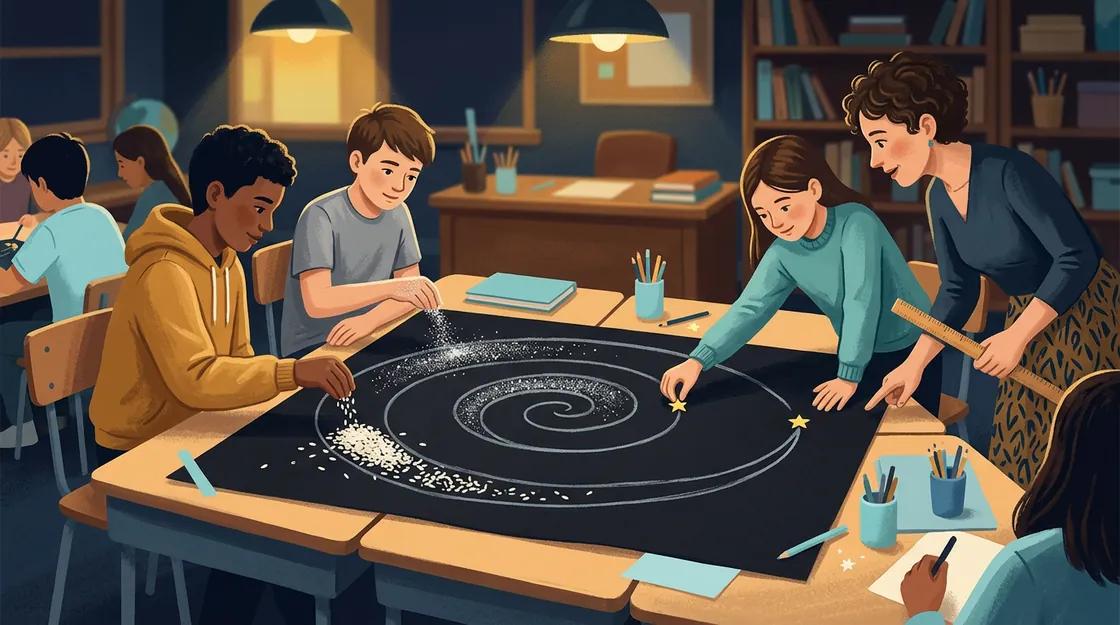
Goal. Students place the Sun in the Milky Way, meet the black hole at its centre, and grasp that looking far away means looking into the past.
Steps in the app
- Press Galaxy. The ship leaves the Solar System and the whole Milky Way appears: 100,000 light-years across, with the Sun two-thirds of the way out.
- Fly to Sagittarius A*, 27,000 light-years away: a black hole of 4.3 million Suns, drawn with its light bent round it.
- Open the Local Universe: 10,933 real galaxies at their real distances. Find the Andromeda Galaxy: its light left about two and a half million years ago.
- Read the note on arrival: what was happening on Earth when the light you see set out.
- Back home, press Search and type "Pleiades": a star cluster you can see with your own eyes, 444 light-years away.
Ask the class
- A light-year is a distance. Why do astronomers measure distance in years?
- If Andromeda's light is millions of years old, do we know what it looks like now?
- Why can we not see the Milky Way's shape from inside it, as Orrery shows it?
Worksheet: a trip through time
Name Class Date
- Distance from the Sun to the centre of the Milky Way, in light-years:
- Pick three objects at different distances (a planet, a star cluster, a galaxy). For each, how old is the light we see?
- What was happening on Earth when the Andromeda Galaxy's light set out?
Answers for the teacher
Lesson 4 · Our galaxy and beyond
Ask the class
- A light-year is how far light goes in a year, about 9.46 trillion km. It says how far away a thing is and, in the same number, how long its light has been travelling.
- No: we see it as it was when the light left. A galaxy changes slowly, so it will look much the same, but anything that happened there since is still on its way to us.
- We are inside the disc, so the Milky Way looks like a band across the sky, and dust hides most of the far side. Its shape comes from mapping the distances and motions of its stars and gas, and from comparing it with other galaxies. Orrery draws that map.
Worksheet
- About 27,000 light-years: galaxy mode puts Sagittarius A* 26,996 light-years from the Sun.
- For example: Neptune, about 4 hours; the Pleiades, 444 years (the light left around 1580); the Andromeda Galaxy, 2.6 million years in galaxy mode, where measurements give 2.4 to 2.6 million.
- The note on arrival says:
when earlier kinds of human were making stone tools
. The first stone tools found so far are 3.3 million years old.
Lesson 5
Landing at the Moon's south pole
In the curriculum. NCERT Curiosity, Grade 7, Ch. 11 “Light: Shadows and Reflections” (11.2 and 11.4, shadows) and Ch. 12 “Earth, Moon, and the Sun” (12.1, rotation); Curiosity, Grade 6, Ch. 12 mentions Chandrayaan-3 near the south pole. NGSS MS-ETS1-1, MS-ETS1-2 (choosing between designs against criteria); MS-ESS1-1 in part.
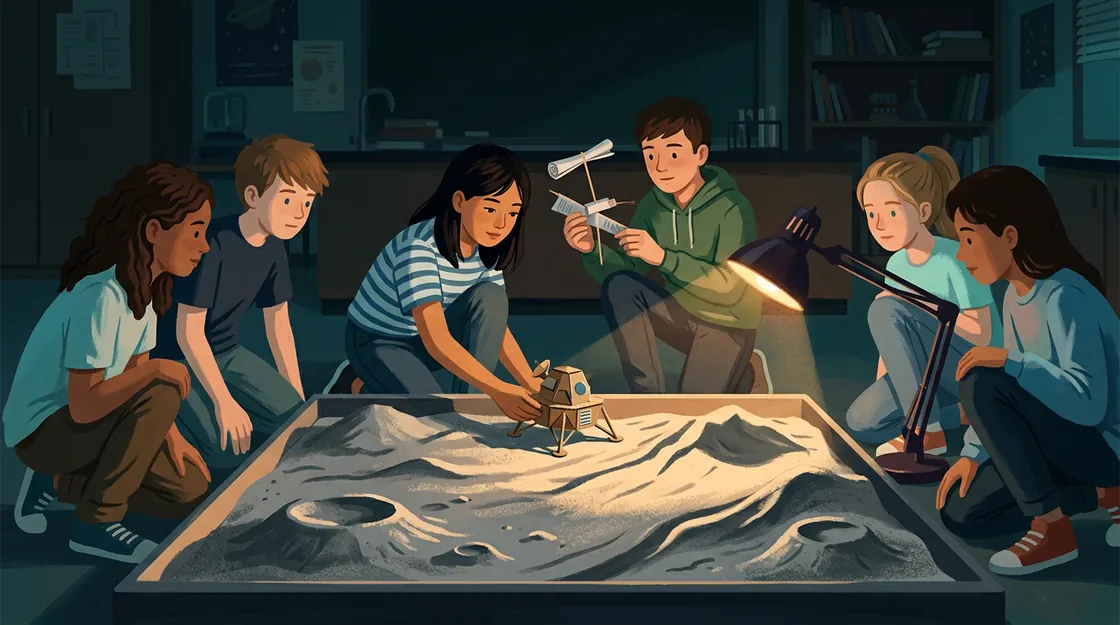
Goal. Students see why the next Moon landings aim at the south pole, read real terrain, and choose a landing site with reasons.
Steps in the app
- Open the Lunar Mission Browser: the south pole in 3D from NASA's laser altimeter, lit for any hour you choose. Drag the time: some crater floors never see the Sun.
- Stand on the surface at the Connecting Ridge: the horizon is the real one, and the Sun skims along it for days.
- Walk with W, A, S, D. The slopes are real; the app stops you where a rover would tip.
- Visit Apollo 11 near the equator and compare: long days, flat ground, no permanent shadow.
- Back at the pole, open a site's card: hours of sunlight, days of Earth contact, and the radio link home.
Ask the class
- Why might ice survive in a crater at the pole but not at the equator?
- A lander needs sunlight for power and Earth in view for radio. Which is harder to find at the pole?
- Apollo landed near the equator in 1969. What has changed that makes the pole worth the difficulty?
Worksheet: choose a landing site
Name Class Date
- Pick one south-pole site in the browser. Its name and latitude:
- Hours of sunlight in its best month, and days of Earth contact:
- Name one advantage and one danger of your site.
- Would you land there? Give your reason in two sentences.
Answers for the teacher
Lesson 5 · Landing at the Moon's south pole
Ask the class
- At the pole the Sun never climbs more than a degree or two above the horizon, so the floors of deep craters are never lit. LRO measured some colder than −230 °C, cold enough to keep ice for billions of years. Near the equator the Sun stands high and the ground reaches about 127 °C by day.
- Often Earth. From the pole Earth always sits low on the horizon, and for about half of each month it dips behind the hills, while the best ridges are sunlit most of the year. Each site's page in Landing sites gives both, month by month.
- Orbiters found water ice in the polar shadows: LCROSS hit Cabeus crater in 2009 and saw it. Ice means water, air and rocket fuel made on the Moon, and the ridges beside it have sunlight for power. Landers can also now come down within a few hundred metres of a chosen point.
Worksheet
- For example, Connecting Ridge CR1 at 89.45° S.
- From the site's card for the chosen 30 days: 100% sunlit is 720 hours; a link open half the time is about 15 days. Its page lists the next twelve months.
- Any advantage and danger that fit the numbers: long sunlight or a high ridge, against long blackouts from Earth, steep slopes or cold shadows close by.
- Mark the reasons rather than the choice: a good answer uses the site's sunlight and Earth-contact figures.
Lesson 6
Standing on Mars
In the curriculum. NCERT Curiosity, Grade 8, Ch. 5 “Exploring Forces” (5.4.2 and 5.5, gravity and weight) and Ch. 13 (Mars at the edge of the habitable zone); Grade 7, Ch. 12 (12.1, rotation); Grade 6, Ch. 12 (“Mars has two moons”). NGSS MS-ESS1-3, MS-ESS1-2, MS-PS2-4. Comparing weights on Mars and Earth goes beyond the NCERT chapter.
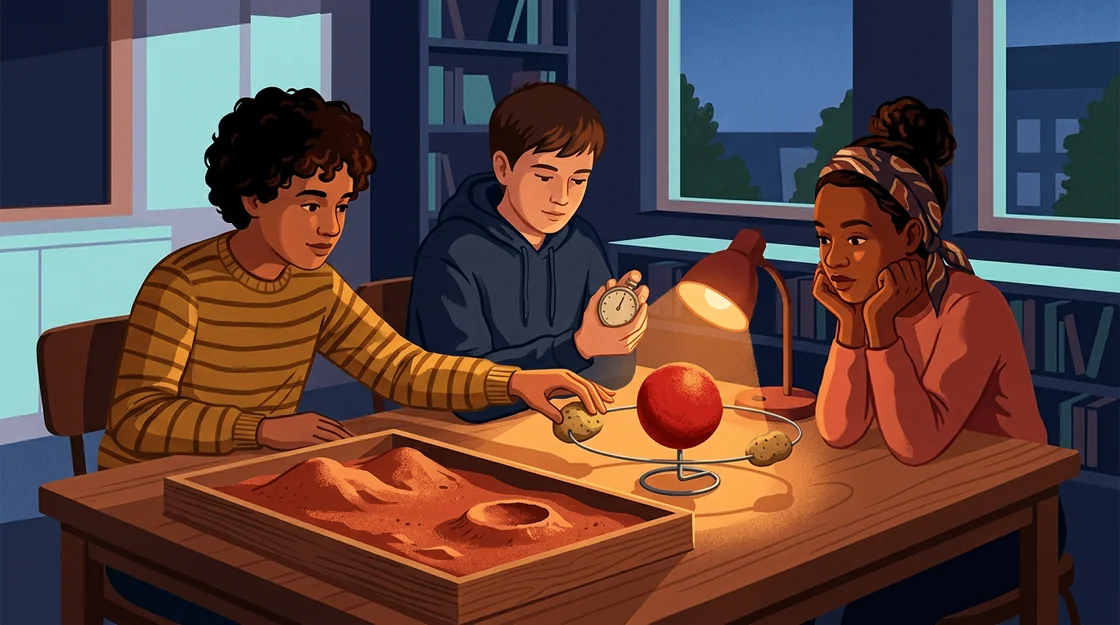
Goal. Students stand on real Martian ground, compare a Martian day, year and weight with ours, and explain why one of Mars's moons rises in the west.
Steps in the app
- Click Mars. Its card gives a day of 24.6 hours, a year of 687 Earth days, and gravity of 3.7 m/s², against Earth's 9.8.
- Press Stand on Mars, or open Jezero crater, where the Perseverance rover landed in 2021. The ground and its colour are from orbiting cameras; look at the colour of the sky.
- Press Play and watch the sky. Then Zoom to Phobos: it rises in the west and sets in the east, twice in a Martian day.
- Press Noon: the Sun looks two-thirds the size it does from Earth. After sunset, look low where it went down: Earth is a bright evening star (or, before sunrise, a morning star).
- Visit Olympus Mons, the tallest volcano in the Solar System, and Melas Chasma, in Valles Marineris, a canyon system more than 3,000 km long.
Ask the class
- A rover's day on Mars lasts about 24 hours 40 minutes. How many Earth days do 30 Martian days take?
- Your mass is the same on Mars. Why would you feel lighter, and by how much?
- The Moon rises in the east like the Sun. Why does Phobos rise in the west?
Worksheet: a week on Mars
Name Class Date
- From Mars's card: the length of its day in hours and of its year in Earth days.
- Mars's gravity is what fraction of Earth's? A 40 kg backpack would feel like how many kilograms there?
- How long does Phobos take to go round Mars? How many times does it cross the sky in one Martian day?
- Draw the sky at Jezero at noon and at night. Label the Sun, Phobos and Earth.
Answers for the teacher
Lesson 6 · Standing on Mars
Ask the class
- About 30.8 Earth days: 30 × 24 h 40 min is 740 hours.
- Weight is gravity's pull on your mass, and Mars pulls with 38% of Earth's force: it has a tenth of Earth's mass, and you would stand about half as far from its centre. You would feel a bit more than a third of your weight.
- Phobos goes round Mars in 7.7 hours, faster than Mars turns (24.6 hours), so it overtakes the turning ground and crosses the sky from west to east. Our Moon takes a month, so Earth's turning carries it from east to west.
Worksheet
- A day of 24.6 hours; a year of 687 Earth days.
- About 38%, a bit more than a third; the 40 kg backpack would feel like about 15 kg.
- Phobos: 7.7 hours (Deimos takes 30.3). Seen from the turning ground it crosses the sky about twice a Martian day.
- A dusty, butterscotch sky by day with a small Sun; at night Phobos moving fast against the stars and Earth as a bright star near the Sun's side of the sky.
Lesson 7
Kepler's laws with the star S2
In the curriculum. NCERT Curiosity, Grade 8, Ch. 5 “Exploring Forces” (5.4.2, gravity); Kepler's laws are not in Classes 6 to 8. NGSS HS-ESS1-4 as an extension: MS-ESS1-2 leaves Kepler's laws out of its assessment.
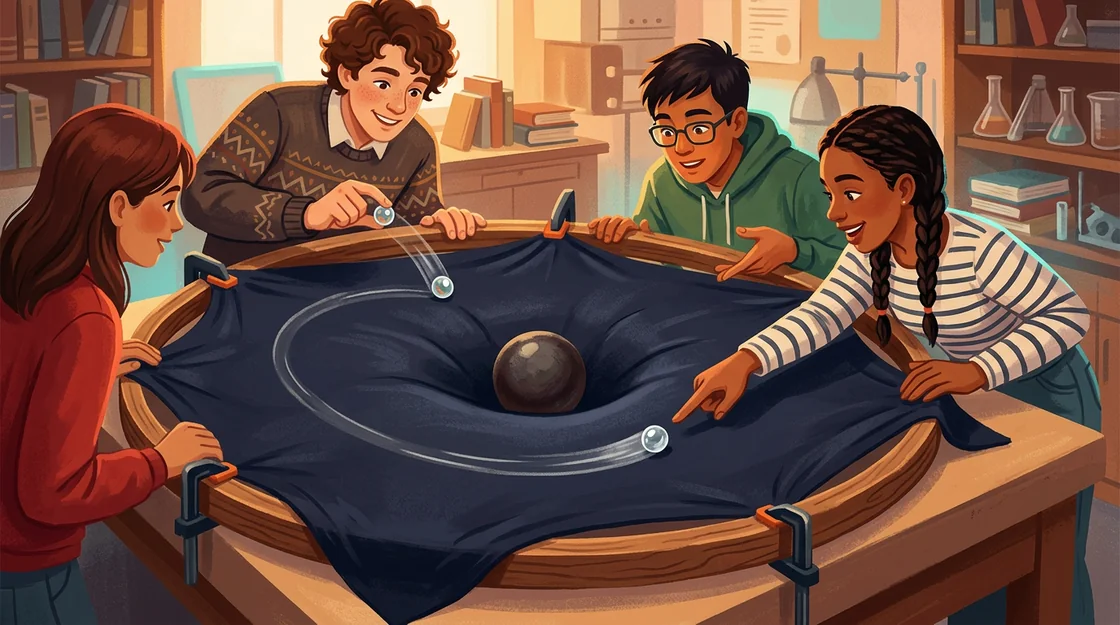
Goal. Students see an orbit speed up near the mass it goes round, state Kepler's second law in their own words, and learn how astronomers weighed the black hole at the centre of the Milky Way.
Steps in the app
- Click Halley's Comet and follow its orbit: it swings close to the Sun and out beyond Neptune. Where does it move fastest?
- Open the S2 race. S2 is a star about 14 times the Sun's mass going round Sagittarius A*, the Milky Way's black hole, on the best-measured orbit in astronomy.
- Race S2 through its real close pass of May 2018. Hold Faster as it falls in: it speeds up to about 7,700 km/s.
- Stay in the green band: you keep up with S2 only if you speed up as it nears the hole and slow down as it climbs away.
- Read the race's notes at the end: how much faster S2 goes at its closest point than at its farthest.
Ask the class
- Where in its orbit does S2 move fastest, and why?
- S2 goes 16 times faster at its closest point than at its farthest. Its closest point is 120 AU from the hole. How far is its farthest?
- How can the size and period of one star's orbit tell us the black hole's mass?
Worksheet: racing S2
Name Class Date
- S2's closest distance from the black hole, and its speed there:
- Its speed at the far end of its orbit. How many times slower is that?
- Kepler's second law in your own words:
- S2 takes 16 years to go round. In what year will it next pass closest?
Answers for the teacher
Lesson 7 · Kepler's laws with the star S2
In the app
- Halley's Comet is fastest at its closest to the Sun, 0.59 AU, and slowest at its farthest, 35.1 AU.
Ask the class
- At its closest point to the black hole. As it falls in, gravity pulls it faster; as it climbs out, gravity slows it.
- About 1,900 AU: at the two ends the speed times the distance is the same, so 16 times slower means 16 times farther. The orbit's measured far point is 1,950 AU.
- Kepler's third law: the cube of the orbit's size divided by the square of its period gives the mass it goes round. For S2, 1,035 AU and 16.05 years give 4.3 million Suns.
Worksheet
- 120 AU, at about 7,750 km/s as the race works it out from the orbit (the speed measured in 2018 was about 7,650 km/s).
- 476 km/s, about 16 times slower.
- A line from the black hole to the star sweeps out equal areas in equal times, so the star moves fast when close and slowly when far.
- In 2034: May 2018 plus 16.05 years.
In the curriculum
What each lesson supports, in India's NCERT science books for Classes 6 to 8 (the Curiosity series, reprint 2026–27) and in the US Next Generation Science Standards. A match is listed only where the chapter covers the topic.
| Lesson | NCERT Curiosity | NGSS |
|---|---|---|
| 1 · Scale | Grade 6, Ch. 12 (12.3) | MS-ESS1-3 |
| 2 · Moon phases | Grade 7, Ch. 12 (12.3); Grade 8, Ch. 11 (11.1.1) | MS-ESS1-1 |
| 3 · Exoplanets | Grade 8, Ch. 13 (13.3.1) | MS-ESS1-3, as an extension |
| 4 · The Milky Way | Grade 6, Ch. 12 (12.4, 12.5) | MS-ESS1-2; HS-ESS1-2 in part |
| 5 · The Moon's south pole | Grade 7, Ch. 11 (11.2, 11.4), Ch. 12 (12.1) | MS-ETS1-1, MS-ETS1-2; MS-ESS1-1 in part |
| 6 · Mars | Grade 8, Ch. 5 (5.4.2, 5.5), Ch. 13; Grade 7, Ch. 12 (12.1); Grade 6, Ch. 12 | MS-ESS1-3, MS-ESS1-2, MS-PS2-4 |
| 7 · Kepler and S2 | Grade 8, Ch. 5 (5.4.2); Kepler's laws are beyond Classes 6 to 8 | HS-ESS1-4, as an extension |
The NGSS codes: MS-ESS1-1, a model of the Earth–Sun–Moon system for phases, eclipses and seasons; MS-ESS1-2, gravity's part in the motions of the Solar System and galaxies; MS-ESS1-3, the scale and properties of Solar System objects from data; MS-ETS1-1 and -2, defining a design problem and judging solutions against it; MS-PS2-4, that gravity attracts and depends on the masses; HS-ESS1-2, the evidence for the Big Bang; HS-ESS1-4, predicting orbital motion with mathematics. The old Class 8 chapter "Stars and the Solar System" was dropped in NCERT's 2022 rationalisation; its topics now sit in the chapters above.
Sources: NCERT, Grade 6 Ch. 12, Grade 7 Ch. 11, Ch. 12, Grade 8 Ch. 5, Ch. 11, Ch. 13; NGSS, MS-ESS1, MS-PS2, MS-ETS1, HS-ESS1.
New to Orrery?
The guide walks through everything the app can do, in three levels. Every world also has a page you can print in Explore.
StartOnline 3D model